The version-aware knowledge graph for coding agents.
Your agents forget your architecture rules, re-learn the same library quirks, and drift from the spec. Vekno gives every agent the same reviewed context, inside a token budget you control.
brew install uasouz/tap/veknovekno init --from-repo && vekno serve --port 7420- Avg bundle size
- 2.1k tok
- vs. 28k+ doc dump
- Local indexing
- < 20 ms
- incremental update
- Data portability
- 100%
- exportable Markdown
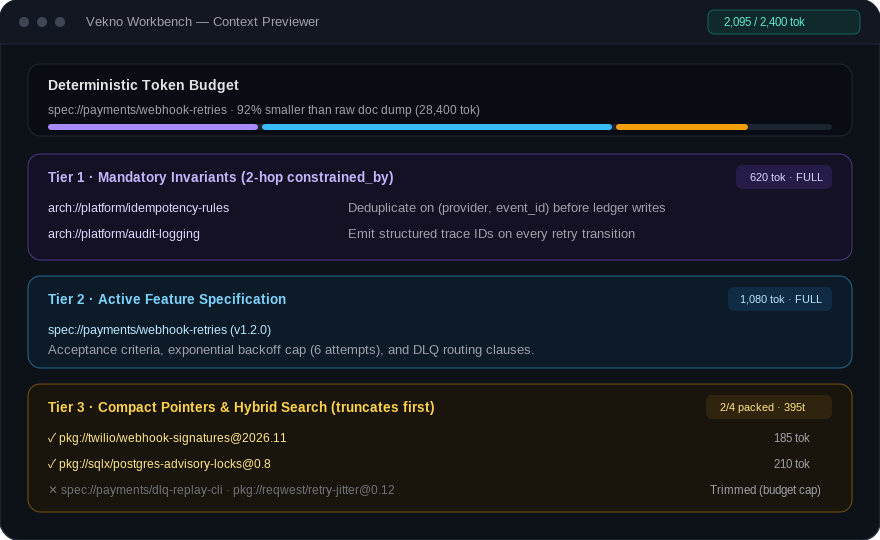
arch://platform/idempotency-rulesarch://platform/audit-logging
spec://payments/webhook-retriesAcceptance criteria, retry cap, DLQ routing, and signature verification.
pkg://twilio/webhook-signatures@2026.11185 tokpkg://sqlx/postgres-advisory-locks@0.8210 tokspec://payments/dlq-replay-cli240 tokpkg://reqwest/retry-jitter@0.12trimmed
Why Vekno
Stop pasting architecture rules into every agent session.
Vekno replaces ad-hoc prompt hygiene with a single local daemon (veknod) that enforces constraints, tracks spec drift, and captures reviewed knowledge.
Rules scattered across AGENTS.md, wikis, and chat threads
One typed, versioned knowledge graph shared by every agent
Agents get the whole document dump or nothing at all
Deterministic 3-tier bundle that always fits your token budget
Nobody notices when code quietly leaves the spec behind
vekno drift flags unverified commits against your spec before merge
Library quirks and discoveries vanish when the session ends
Agent learnings stage in an inbox for 1-click human review
How it works
From scattered repo docs to reviewed agent context in three steps.
- 01
Import
Reads your existing AGENTS.md, ADRs, and project rules into structured nodes without forcing a rewrite.
vekno init --from-repo - 02
Serve
Runs veknod locally so every coding agent receives the exact same reviewed context over MCP.
vekno serve --port 7420 - 03
Review
Approve what agents learn in the inbox, inspect spec coverage, and catch drift before pull requests merge.
vekno drift && vekno inbox list
Product
Built for teams running real coding agents every day.
Every vault ships with an embedded local workbench at 127.0.0.1:7420—and your knowledge stays always exportable to plain Markdown.
Context Bundles
Control every token before an agent starts coding.
See the exact token budget breakdown across mandatory architecture rules, the active spec, and optional library pointers—plus exactly what was trimmed and why.
- Architecture rules stay full; lower-priority pointers trim first
- Pass a previous spec version to send only what changed
- Average bundle uses ~2.1k tokens instead of dumping 28k+ tokens of docs
Spec Review
Spot vague clauses before agents guess the wrong behavior.
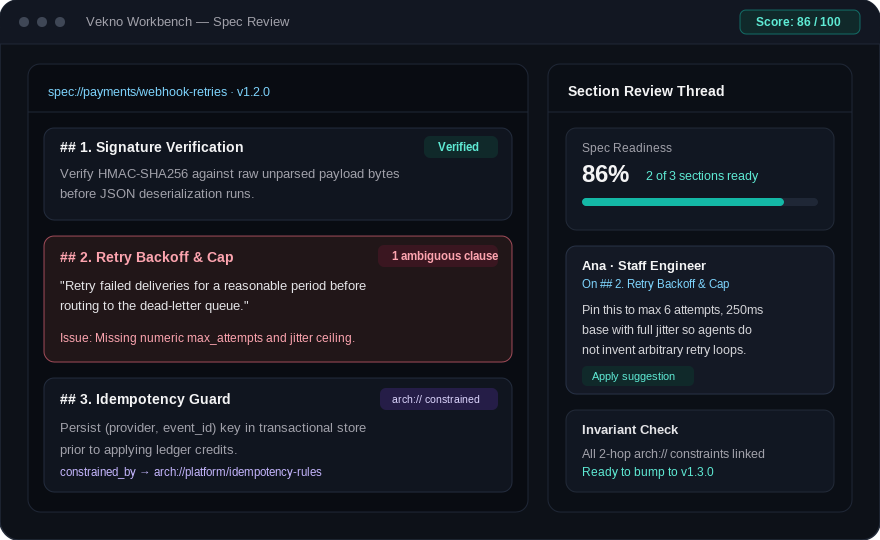
Score every living spec for clarity and coverage, highlight underspecified clauses, and resolve section-level review comments right beside your linked architecture constraints.
- Section-level readiness score and missing-constraint checks
- Inline review threads pinned to exact Markdown headings
- Versioned intent history so resuming agents see why a rule changed
Pain Points
Know where your documentation is failing your agents.
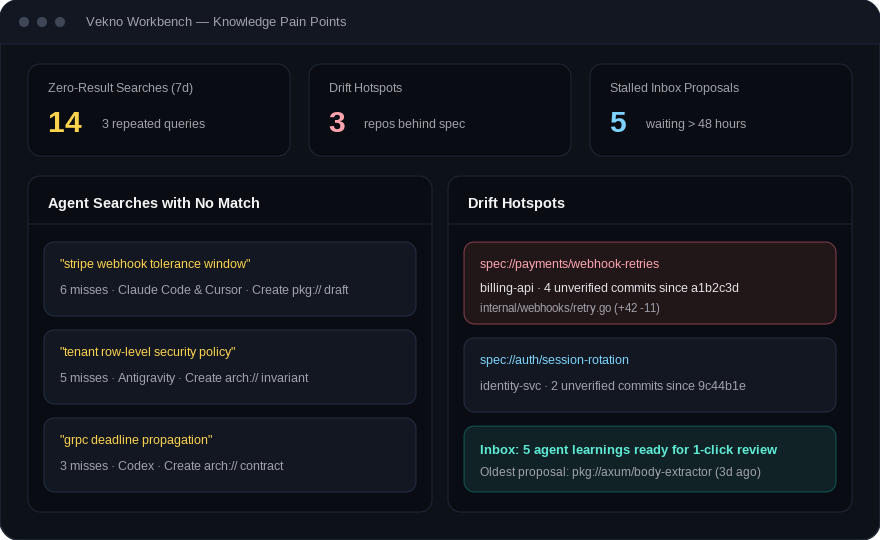
Surface zero-result agent searches, repositories drifting behind verified specs, and stalled inbox proposals in one view so teams document what actually matters.
- Repeated zero-result queries turn into one-click draft nodes
- Drift hotspots rank specs by unverified commits across repos
- Track pending agent proposals so learnings never go stale
Epic to Spec
Turn a Linear or Jira epic into a reviewed spec draft.
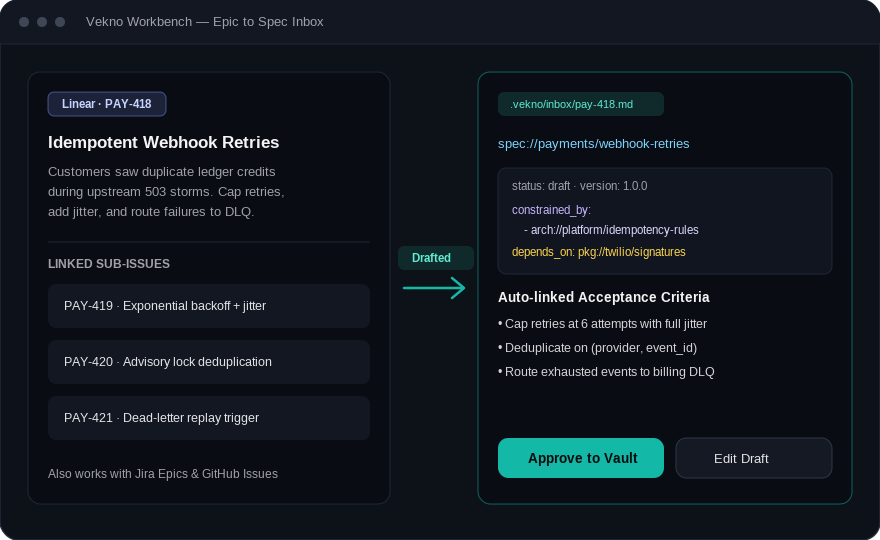
Pull an epic and its sub-issues straight into the Vekno inbox as a structured spec draft, pre-linked to your existing architecture rules and library notes.
- Drafts land in the inbox—canonical vaults are never mutated silently
- Auto-links relevant architecture constraints and dependencies
- Approve into your vault and bind directly to a Git worktree
Integrations
One knowledge graph across every coding agent and tracker.
Connect Claude Code, Antigravity, Cursor, and Codex in one command over MCP, then tie specs directly to Linear, Jira, and GitHub pull requests.
Connect your coding agent
# Wire Claude Code skill + local MCP servervekno setup --target claudevekno doctorConfigures ~/.claude/skills/vekno/ and ~/.claude.json (or project .mcp.json) so Claude pulls reviewed bundles automatically.
Inspect the 6 MCP toolsLinear
Epic to Spec DraftTurn a Linear epic and its sub-issues into a structured spec draft in your Vekno inbox, linked to relevant architecture rules.
Team & Enterprise
Jira
Enterprise SyncImport Jira epics into living specs and keep acceptance criteria synchronized without copying tickets manually into prompts.
Team & Enterprise
GitHub
PR Drift GateRun vekno drift in pull requests to flag commits that diverged from verified specs before code reaches main.
CLI in Community · Hosted Gate in Team
Comparison
How Vekno compares to the alternatives.
Verified capabilities across plain Markdown rules, spec templates, remote doc lookups, and built-in vendor memory.
| Capability | Vekno | Plain AGENTS.md | Spec Kit | Context7 | Agent Memory |
|---|---|---|---|---|---|
| Works across multiple agents | |||||
| Deterministic token budget | |||||
| Spec-to-code drift detection | |||||
| Human review inbox before writes | |||||
| Runs 100% offline locally | |||||
| Open source |
Legend: Check = supported natively, Dash = partial or plan-dependent, Cross = not supported.
Open Source · AGPL-3.0
The core is AGPL-3.0. Use it, read it, self-host it.
Using the Vekno binary and connecting your coding agents does not affect the license of your code. Your specs and architectural rules stay yours, always exportable to plain Markdown.
Need a commercial license for an organization that does not adopt AGPL? See the Enterprise plan below.
Plans
Start locally for free. Scale across teams when ready.
Full local core under AGPL-3.0 forever, with shared team governance and commercial Enterprise licensing from Arkon.
Community
Free
AGPL-3.0 open-source license
- Full local core, CLI, and embedded Workbench UI
- All coding agents via MCP (Claude Code, Antigravity, Cursor, Codex)
- Local drift checks, worktree bindings, and inbox review
Team
WaitlistFlat price per team
No per-token markups
- Shared daemon, SSO, role-based access, and audit log
- Linear & Jira epic-to-spec sync
- Automated GitHub PR drift gate
Enterprise
Annual contract
Commercial non-AGPL license
- Commercial license for non-AGPL organizations
- Air-gapped deployment & signed binary releases
- Dedicated SLA, security review, and team onboarding
Talk to Arkon about Enterprise
Tell us about your team size and deployment requirements. We reply within one business day with commercial licensing and air-gap packaging details.
FAQ
Common questions
Is my code or knowledge sent anywhere?
No. Vekno and its local daemon (veknod) run completely on your machine or inside your own network, binding to 127.0.0.1 by default. Your Markdown vaults, specs, Git diffs, and local search indexes never leave your environment.
What does AGPL-3.0 mean for my company?
You can download, run, and self-host Vekno for free inside your company. Running the Vekno binary and connecting your coding agents to it does not affect the license of your own codebases or specs. AGPL-3.0 only applies if you modify Vekno itself and distribute or host a modified Vekno service. Organizations with policies against AGPL can purchase a commercial Enterprise license from Arkon.
Do I need embeddings? Which model runs locally?
Embeddings are completely optional. Vekno indexes text first so lexical search works immediately on every save, and you can disable embeddings completely with vekno serve --no-embed. When enabled, a local ONNX embedding worker runs in the background on your machine—no external API keys required.
How is this different from AGENTS.md or my agent’s built-in memory?
AGENTS.md files grow unwieldy and have no graph traversal, token budget, or drift verification. Built-in agent memory is locked to a single vendor and mutates silently without review. Vekno gives every agent the same versioned rules inside a strict token budget, flags code drift against specs, and stages new learnings for human approval.
Can I get my data out?
Always. Your knowledge is stored in plain Markdown with YAML frontmatter and is always exportable to plain Markdown in Git. Local search indexes are completely disposable and rebuildable—there is zero proprietary lock-in.
Which coding agents are supported?
Any agent that speaks MCP (over stdio or Streamable HTTP) works out of the box. vekno setup provides one-command wiring for Claude Code, Antigravity, Cursor, Codex, and Paseo, and the vekno CLI provides full terminal fallbacks.
Give every coding agent the same reviewed truth.
Install Vekno in seconds, import your existing repo rules, and keep your knowledge exportable to plain Markdown.